> For the complete documentation index, see [llms.txt](https://docs.hello-robot.com/llms.txt). Markdown versions of documentation pages are available by appending `.md` to page URLs; this page is available as [Markdown](https://docs.hello-robot.com/stretch4_docs/working-with-stretch/nav_u/navigation-coordination.md).

# Navigation Coordination

We have gone through how the global planner works, and how the global plan informs the local planner. The last major step of this navigation exploration is to show how these pieces interact through time.

## Base Case

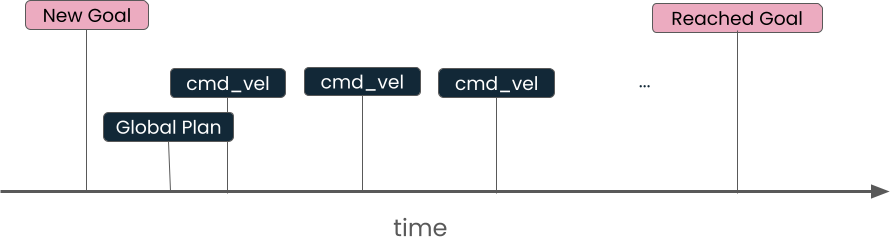
In the ideal world, we can compute the global plan once right after we receive the goal pose, and then use the local planner to produce command velocities to get to the goal.
<div align="center"><img src="/files/WFrzlRrto0VbMI2vZ615" alt="base" width="400"></div>

You could coordinate this by writing a node that first calls the `ComputePathToPose` action (getting you the global plan), and then passing this to the `FollowPath` action.

However, when navigating the real world, the environment can change and the planners can fail. In the case, you will need a more complex control flow.

## Repeated Global Planning

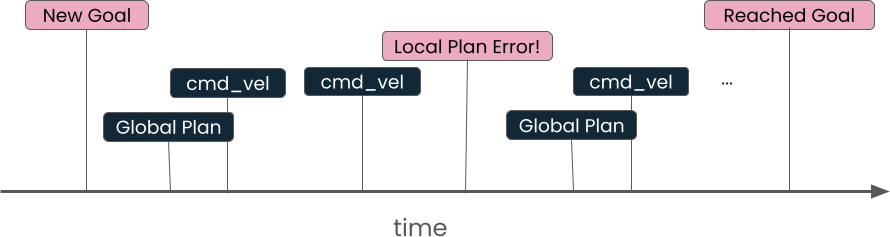
One approach to dealing with local planning failures is to trigger global planning. If there is an obstacle in the robot's path blocking the local planner, create a new global plan that goes around it.

<div align="center"><img src="/files/6oIRYijaymT3vEFV7wUH" alt="base" width="400"></div>

This is a more robust control flow than just giving up when a failure is detected, but still could handle more cases. For the more complex examples, we’ll need a more sophisticated data structure.

## Behavior Trees

Behavior trees are a way of describing a control flow for any type of process, and are used extensively in ROS and Nav2. We’re using XML-based [BehaviorTree.CPP](https://www.behaviortree.dev/docs/intro) and you should look at their site to learn the details of the system.

Let’s explore an example similar to the Nav-specific example given in the [core Nav2 behavior tree documentation](https://docs.nav2.org/behavior_trees/index.html).

```xml
<root main_tree_to_execute="MainTree">
  <BehaviorTree ID="MainTree">
    <PipelineSequence name="NavigateWithReplanning">
      <ComputePathToPose goal="{goal}" path="{path}"/>
      <FollowPath path="{path}"/>
    </PipelineSequence>
  </BehaviorTree>
</root>
```

For the moment, we can ignore the `root` element. In English, we would say that this behavior tree is a sequence containing two "branches". The first branch is the `ComputePathToPose` action, which we know takes in a goal and produces a path. The second branch is the `FollowPath` action, which uses that path. The two branches being part of a sequence means that each action is done sequentially, i.e. one after the other.

This example is equivalent to the Base Case approach we discussed earlier, which we know has shortcomings.

## Replanning and Recovery Behavior Tree

By default, our navigation configuration for Stretch 4 uses the [`NavigateToPose with Replanning and Recovery`](https://github.com/ros-navigation/navigation2/blob/jazzy/nav2_bt_navigator/behavior_trees/navigate_to_pose_w_replanning_and_recovery.xml) behavior tree.

Let’s start with a small snippet of that tree:

```xml
<RecoveryNode number_of_retries="1" name="ComputePathToPose">
  <ComputePathToPose goal="{goal}" path="{path}" planner_id="{selected_planner}" error_code_id="{compute_path_error_code}"/>
  <Sequence>
    <WouldAPlannerRecoveryHelp error_code="{compute_path_error_code}"/>
    <ClearEntireCostmap name="ClearGlobalCostmap-Context" service_name="global_costmap/clear_entirely_global_costmap"/>
  </Sequence>
</RecoveryNode>
```

A recovery node has exactly two branches: If the first one fails, it will attempt to do the second. So if `ComputePathToPose` fails, it will attempt the recovery sequence listed, including clearing the global costmap.

The snippet above is surrounded by `<RateController hz="1.0">`, which means that `ComputePathToPose` is computed once every second.

The `FollowPath` action is similarly surrounded by a recovery node with its own costmap clearing recovery.

The combined `ComputePathToPose`/`FollowPath` sequence is itself surrounded by a recovery node, with a `RoundRobin` selection of different recoveries for it to try in sequence.


---

# Agent Instructions
This documentation is published with GitBook. GitBook is the documentation platform designed so that both humans and AI agents can read, navigate, and reason over technical content effectively. Learn more at gitbook.com.

## Querying This Documentation
If you need additional information that is not directly available in this page, you can query the documentation dynamically by asking a question.

Perform an HTTP GET request on the current page URL with the `ask` query parameter:

```
GET https://docs.hello-robot.com/stretch4_docs/working-with-stretch/nav_u/navigation-coordination.md?ask=<question>
```

The question should be specific, self-contained, and written in natural language.
The response will contain a direct answer to the question and relevant excerpts and sources from the documentation.

Use this mechanism when the answer is not explicitly present in the current page, you need clarification or additional context, or you want to retrieve related documentation sections.
